To tell a real Rolex Submariner from a fake, work through five components in order: the cyclops date lens (which should magnify the date 2.5×), the rehaut engraving (cleanly laser-cut and perfectly aligned), the case weight (genuine Oystersteel feels dense and substantial), the crown logo and crystal etching (sharp coronet, microscopic crown at six o'clock), and the movement (a smooth-sweeping seconds hand, never a tick). No single check is conclusive on its own, but a counterfeit almost always fails at least two of them. The most reliable tells are the cyclops magnification and the seconds-hand sweep. Both are difficult and expensive to fake well, and both can be assessed in seconds.
The Submariner is the most counterfeited luxury watch in the world, which is precisely why it rewards a methodical eye. Modern "super clones" have closed the gap on the obvious giveaways (the spelling errors and rattly bracelets are mostly gone), so authentication today is a game of accumulated detail, not one knockout punch. This walkthrough goes component by component, the way a watchmaker does it on the bench, so you know what genuine looks like and where the fakes still slip.
A note on scope: this guide trains your eye and helps you reject obvious fakes. It is not a substitute for opening the case and inspecting the movement, serial, and hallmarks under magnification: the final word on any high-value purchase. The safest authentication is one you don't have to do alone.
How can you tell if a Rolex Submariner is real or fake?
The fastest read combines two checks that counterfeiters struggle with: the date magnification and the seconds hand. Look at the date through the cyclops. On a genuine Submariner Date it should be enlarged 2.5 times, filling the window crisply. Then watch the seconds hand for ten seconds. A real Submariner sweeps in tiny, near-continuous steps (its movement beats at 28,800 vibrations per hour, roughly eight steps a second). A cheap fake ticks once per second, visibly and audibly.
If a watch passes both of those, slow down and go through every component below. If it fails either, you almost certainly have a counterfeit and don't need to go further.
Step 1: Check the cyclops date lens (2.5× magnification)
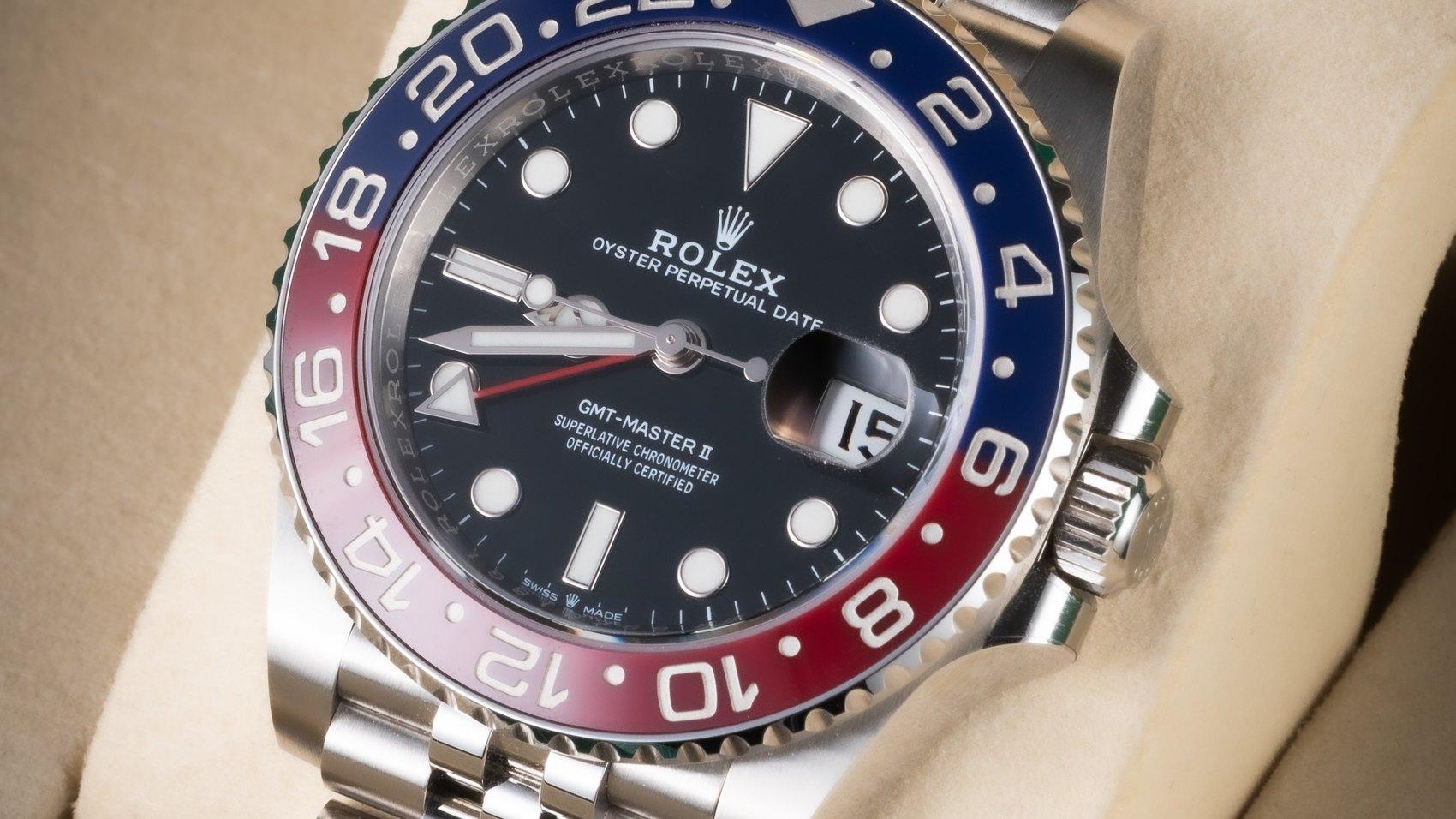
The cyclops is the small bubble of crystal over the date window, and it is one of the hardest features to counterfeit correctly.
On a genuine Submariner:
- The date is magnified 2.5×, so it fills the cyclops window cleanly and sits sharp and legible.
- The lens is sapphire, with an anti-reflective coating underneath that kills glare. The date reads clearly even at an angle.
- The cyclops is perfectly centered over the date aperture.
- The date numerals are slim, evenly spaced, and crisply printed.
On a fake:
- Magnification is typically weaker (often around 1.5× or none at all), so the date looks small, flat, and undersized.
- The numerals may appear thick, "bubbly," or crowded together.
- The lens often carries a visible tint or heavy reflection from certain angles.
- The cyclops may sit slightly off-center over the window. Even a hair of misalignment is a red flag.
Takeaway: if the date doesn't visibly swell to fill the cyclops, treat the watch as suspect. This single check eliminates a large share of counterfeits.
Step 2: Inspect the rehaut engraving
The rehaut is the inner ring of the dial, between the dial edge and the crystal. From roughly 2007–2008 onward, Rolex laser-engraves "ROLEX" repeated around this ring, with a crown logo at 12 o'clock and the watch's serial number at 6 o'clock.
What genuine looks like:
- Engraving is clean, even, and deeply laser-cut, not painted or acid-etched.
- The repetition is mathematically regular. On an authentic piece, the engraving aligns precisely with the dial markers: the final "X" in "ROLEX" lines up consistently with the minute track.
- The serial at 6 o'clock is crisp, with consistent depth and spacing.
What fakes get wrong:
- Super clones have learned to engrave the rehaut, but they frequently fail the geometry: the text is subtly misaligned with the markers, or the spacing drifts around the ring.
- Lettering may look shallow, "sandy," or dotted under a loupe rather than cleanly cut.
- Fonts can be marginally too thick or thin.
Takeaway: a fake can copy the words but rarely the precision. Look for perfect alignment between the engraving and the dial markers, not just the presence of text.
Step 3: Weigh and handle the case
The Submariner is built from Oystersteel, Rolex's name for an alloy in the 904L family, a corrosion-resistant, high-density steel more common in aerospace and chemical applications than in watchmaking. It is harder and more expensive to machine and finish than the 316L steel most of the industry uses.
That matters for authentication because 904L makes a genuine Submariner feel notably dense and solid in the hand. Counterfeiters cutting costs usually can't reproduce that mass at their price point, so many fakes come in lighter and feel hollow or "tinny" by comparison.
While the case is in your hand, also check:
- The case back. A genuine Submariner has a smooth, plain, solid case back with no engravings and no display window. An exhibition (clear) case back on a Submariner is an instant disqualifier. Rolex does not make one. Counterfeiters love clear case backs precisely because they let buyers admire a decorated (fake) movement.
- The bracelet and clasp. The clasp should close with a precise, solid click. The coronet and "ROLEX" on the clasp should be sharply, deeply engraved, never shallow or fuzzy. The Glidelock micro-adjustment on modern references should operate smoothly with clean, audible clicks.
- Finishing transitions. Genuine cases have crisp, even transitions between brushed and polished surfaces. Fakes often blur these.
Takeaway: weight and finishing are tactile tells. If you've handled a real one, a fake frequently feels wrong before you've checked a single detail.
Step 4: Examine the crown logo and crystal etching
Rolex hides two anti-counterfeiting features in plain sight.
The applied coronet. The crown logo (on the dial and engraved on the winding crown) is one of the hardest details to fake cleanly. Under a loupe, a genuine coronet has crisp, well-defined points with consistent spacing. Fakes often show points that are blobby, uneven, or slightly malformed.
The laser-etched crystal crown. Since the early 2000s, Rolex micro-etches a tiny coronet into the sapphire crystal at the 6 o'clock position. The critical detail: it is so small you should not be able to see it with the naked eye. You need a loupe and good light, and even then it sits subtly within the crystal. If a "Rolex" crown is obvious or large enough to spot without magnification, that's a fake. (On genuine watches the etched crown is also nearly invisible head-on and only catches the light at certain angles.)
Takeaway: the real anti-counterfeiting marks are subtle by design. An over-obvious crystal crown betrays a fake more reliably than a missing one.
Step 5: Assess the movement and seconds hand
This is the bench-level check, and it's where the most expensive fakes still fall short.
The current Submariner Date (reference 126610, introduced in 2020) runs Rolex's automatic Caliber 3235, with a Chronergy escapement, a blue Parachrom hairspring, and roughly a 70-hour power reserve. Earlier modern Submariners use the Caliber 3135. Neither beats like a quartz watch.
What you can check without opening the case:
- The seconds-hand sweep. A genuine Submariner's seconds hand moves in many tiny steps per second: at 28,800 vph that's about eight beats a second, producing a smooth, gliding motion. A once-per-second tick is the signature of a quartz or cheap mechanical clone movement and is a definitive fail.
- Sound. Low-cost clones (often Japanese Miyota or Chinese 2813 movements, sometimes dressed up with a decorated rotor) tend to tick audibly and run with uneven hand motion.
What only a watchmaker should check, with the case open:
- The movement architecture, finishing, and engravings against the genuine Caliber 3235/3135.
- The serial and model numbers, the dial and hand stack, and the hallmarks: verified against Rolex's known specifications for the reference.
Takeaway: the seconds-hand sweep is the single most accessible movement tell. But the case-back inspection is the one that settles a high-value purchase, and it belongs to a trained watchmaker.
Fake Rolex Submariner tells: the checklist
| Component | Genuine Submariner | Common fake tells |
|---|---|---|
| Cyclops date lens | Date magnified 2.5×, fills window, sharp, centered, glare-free | Weak (~1.5×) or no magnification; thick/bubbly numerals; tint; off-center |
| Rehaut engraving | Cleanly laser-cut, perfectly aligned with dial markers | Misaligned text, drifting spacing, shallow "sandy" etching |
| Case weight & back | Dense 904L Oystersteel; smooth, solid, plain case back | Light/hollow feel; exhibition case back (instant disqualifier) |
| Crown logo & crystal | Crisp applied coronet; near-invisible micro-etched crown at 6 o'clock | Malformed coronet points; crystal crown visible to the naked eye |
| Movement | Smooth, gliding seconds sweep (28,800 vph) | Once-per-second tick; audible ticking; uneven hand motion |
| Clasp & bracelet | Solid click; deep, sharp engraving; smooth Glidelock | Shallow/fuzzy engraving; loose action; rattly feel |
Use it as a scorecard. One failed component is enough to walk away. Passing all six earns the watch a professional inspection, not a purchase.
Why is the Submariner faked so often?
Three reasons converge. It is the most recognizable luxury sports watch in the world, so demand for the look is enormous. Its design is comparatively simple (a three-hand diver with a date), which makes it easier to replicate than a complicated chronograph or perpetual calendar. And its market value is high and durable, which gives counterfeiters a wide margin to work with. That combination has made the Submariner the proving ground for "super clone" makers, which is exactly why per-component scrutiny matters more here than on almost any other reference.
What about paperwork, box, and price?
Treat them as supporting evidence, never proof.
- Papers and boxes are routinely faked or mismatched. A convincing card or a "full set" tells you nothing on its own; counterfeiters forge paperwork as readily as dials. Genuine papers should match the watch's serial and reference exactly. A mismatch is a serious warning, but a match is not authentication.
- Price is a signal, not a test. Counterfeit networks deliberately price fakes slightly below market (often a calculated 5–15% under fair value) to feel like a "deal" without screaming scam. A price that looks too good usually is, but a fair price proves nothing.
The watch authenticates the watch. Documents and pricing only ever raise or lower your suspicion before the components do the real work.
FAQ
How can you tell if a Rolex Submariner is real or fake?
Check five components in order: the cyclops should magnify the date 2.5×; the rehaut engraving should be cleanly cut and perfectly aligned with the dial markers; the case should feel dense (it's 904L Oystersteel) with a plain, solid case back; the crown logo should be crisp and the micro-etched crystal crown near-invisible; and the seconds hand should sweep smoothly rather than tick. Failing any one of these strongly suggests a fake.
Does a real Rolex Submariner tick or sweep?
It sweeps. A genuine Submariner's mechanical movement beats at 28,800 vibrations per hour, about eight tiny steps per second, producing a smooth, gliding seconds hand. A once-per-second tick is a hallmark of a quartz or low-cost clone movement and is one of the most reliable signs of a fake.
Is there a magnifying crown etched on the Submariner crystal?
Yes. Since the early 2000s, Rolex laser-etches a microscopic coronet into the sapphire crystal at the 6 o'clock position. It is intentionally so small that it should be invisible to the naked eye. You need a loupe and good light to see it. If the crystal crown is large or easy to spot without magnification, the watch is a fake.
Can a fake Rolex Submariner have real-looking papers?
Yes. Counterfeiters forge paperwork, warranty cards, and boxes as readily as they fake watches, and "full set" presentations are common on counterfeits. Papers should match the watch's serial and reference exactly, but a clean set is never proof of authenticity. The physical watch, inspected component by component, is what authenticates a Submariner.
What's the easiest single check to spot a fake Submariner?
Watch the seconds hand for ten seconds. A smooth sweep points to a genuine mechanical movement; a once-per-second tick almost certainly means a quartz or cheap clone caliber. Pair it with the cyclops magnification check (the date should clearly swell to 2.5×) and you'll catch the large majority of fakes in under a minute.
Should I open the case back to check the movement?
Not yourself. The case back is solid and removing it requires the correct tools and technique. Done wrong, you can damage the watch or void its integrity. The movement, serial, and hallmark inspection that truly settles authenticity should be performed by a trained watchmaker, who compares the caliber and engravings against Rolex's known specifications for the reference.